DOG HEALTH · SKIN & COAT
Why Does My Dog Keep Scratching and Licking?
A practical guide to common triggers, the role of daily nutrition and when it is time to speak with your vet.
Buddy publishes practical dog-health education and makes the daily canine supplement discussed in this guide.
The short answer
Dogs scratch and lick for many reasons. Seasonal or environmental irritants, dry skin, diet, grooming products, parasites and underlying health issues can all play a part, and more than one factor may be involved. Look at the pattern: when the behaviour started, how often it happens and whether anything else has changed.
Persistent, severe or sudden symptoms should be discussed with a veterinarian, especially when the skin is broken or your dog seems unwell. Daily nutrition can provide nutrients that support normal skin barrier function and coat condition over time. It cannot identify the cause of scratching or licking, and a supplement cannot diagnose or treat the underlying problem.
A useful 60-second check
Before you change anything, notice the pattern
Note where it happens, when it is worse and what changed. Share those observations with your vet.
- 01
Where does it happen?
Paws, face, ears, belly, back or all over?
- 02
When is it worse?
At night, after walks, after meals or following grooming?
- 03
What changed?
Season, food, treats, shampoo, bedding, parasite prevention or routine?
Does any of this look familiar?
- Licking or chewing paws
- Scratching during the night
- Rubbing the face on carpet or furniture
- Dry-looking or flaky skin
- Increased shedding
- A dull or rough coat
- Redness beneath the fur
These signs can have different causes. The checklist is a way to record what you notice, not diagnose your dog.
What may be contributing
Seasonal and environmental irritants
Pollen, grass, dust and humidity changes may coincide with scratching or paw licking.
Dry skin and grooming factors
Dry air, frequent bathing or a change in shampoo can affect skin and coat condition.
Diet and nutritional gaps
Skin and coat need dietary fats, protein and micronutrients. Ask your vet to assess the complete diet before assuming something is missing.
Health issues requiring veterinary attention
Parasites, infections, pain and other health issues can look similar. A vet can assess the underlying cause.
Where daily nutrition fits
Skin and coat need fatty acids, amino acids, antioxidants and other nutrients from a complete diet. These help maintain normal skin renewal and coat structure.
A daily supplement can provide additional nutritional support, but it cannot tell you why your dog is scratching. Support is gradual, so consistency matters. Keep appropriate food, grooming, parasite prevention and veterinary care in place.
This is the reason Buddy was designed as one measured, tear-and-pour daily sachet.
Meet Buddy
Daily skin and coat support, without changing their food
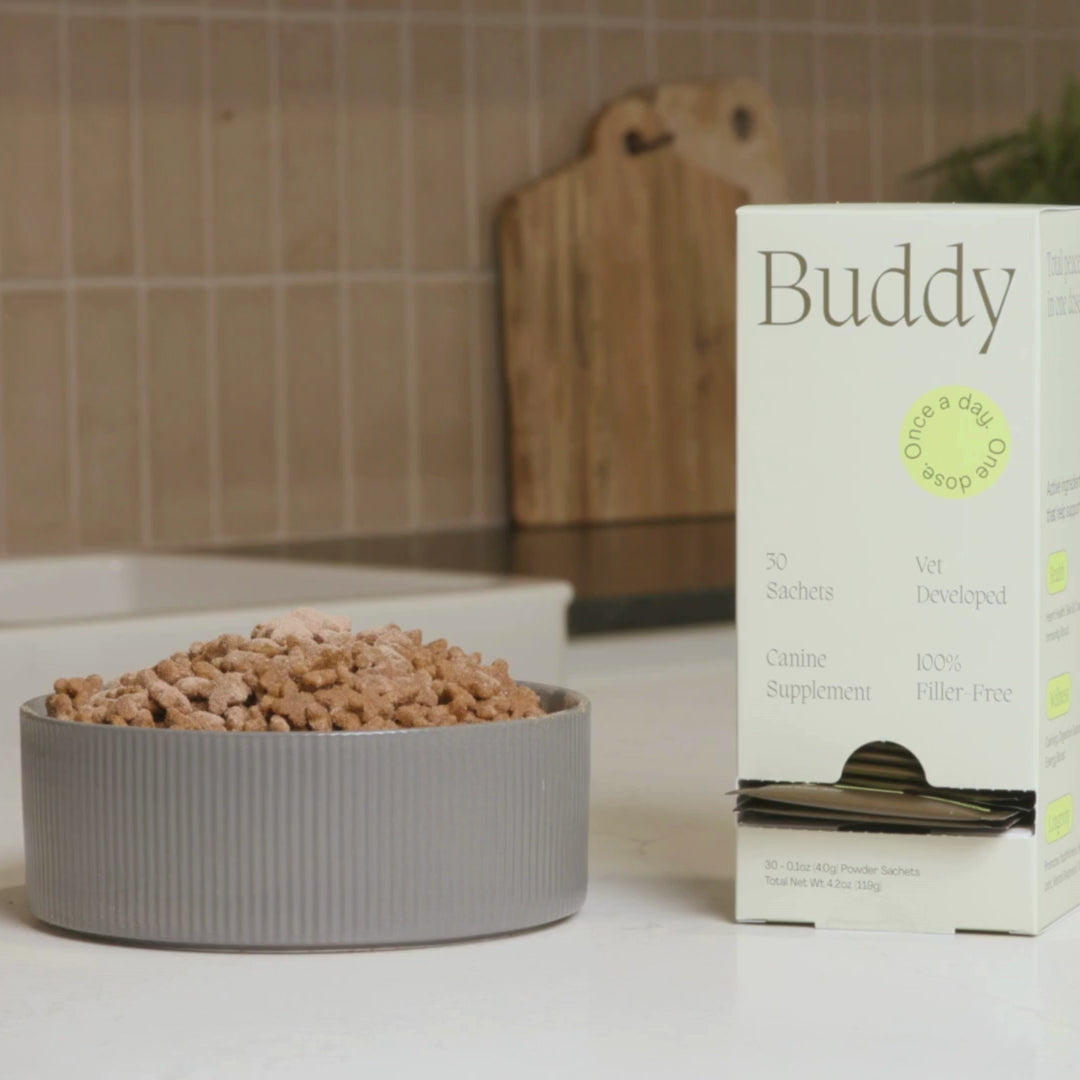
Buddy combines 23 active ingredients in one pre-portioned daily sachet. Tear it open and pour it over the wet or dry food your dog already eats.
- Vet developed
- 23 active ingredients
- 14 calories per sachet
- No fillers
Tear. Pour. Done.One sachet over normal food, once daily.
Inside Buddy: daily support for skin and coat
A closer look at three of Buddy’s 23 active ingredients, what they are and why they’re included.
-
01
 250 mg per serving
Omega-3 Algae
For skin and coat: Omega-3 fatty acids are part of normal skin and coat nutrition. Buddy provides algae-derived DHA as part of its daily formula.
What it is: Algal oil is a source of DHA, a long-chain omega-3 fatty acid.
Also supportsResearch: DHA-rich diets and puppy development- Hip & joint
- Immunity
- Mental sharpness
- Vision
- Healthy ageing
Studied learning, immune response and retinal function in puppies, not skin or coat outcomes.
-
02
 50 mg per serving
Quercetin
For skin and coat: Provides antioxidant support and helps maintain normal immune responses involved in healthy skin.
What it is: A plant compound called a flavonoid, with antioxidant activity.
Also supportsResearch: a quercetin blend and digestive markers- Digestion
- Hip & joint
- Immunity
Studied a blend of quercetin, bromelain and shiitake in dogs. It did not isolate quercetin’s effects or test skin outcomes.
-
03
 20 mg per serving
Coenzyme Q10
For skin and coat: Supports antioxidant defence and normal cell energy, including in cells involved in skin maintenance.
What it is: A compound that helps cells produce energy and also acts as an antioxidant.
Also supportsResearch: CoQ10 in dogs with heart disease- Heart health
- Energy
- Healthy ageing
Studied dogs with mitral valve disease, not skin or coat outcomes. It was not a trial of Buddy.


Research links describe studies of individual ingredients or multi-ingredient formulas. They do not show that Buddy diagnoses, treats or prevents skin conditions.
 Veterinary perspective